Should you buy your espresso machine outright, take out a lease, or rent it on a service-included contract? It is one of the largest capital decisions a café owner makes — and one of the easiest to get wrong. The wrong choice can lock thousands of euros of capital into equipment that is depreciating faster than expected, or commit you to monthly outflows that hollow out your margin in the lean months. Here is the arithmetic, with a worked five-year comparison, and the decision framework we use with our hospitality clients.
Why this question matters more than it sounds
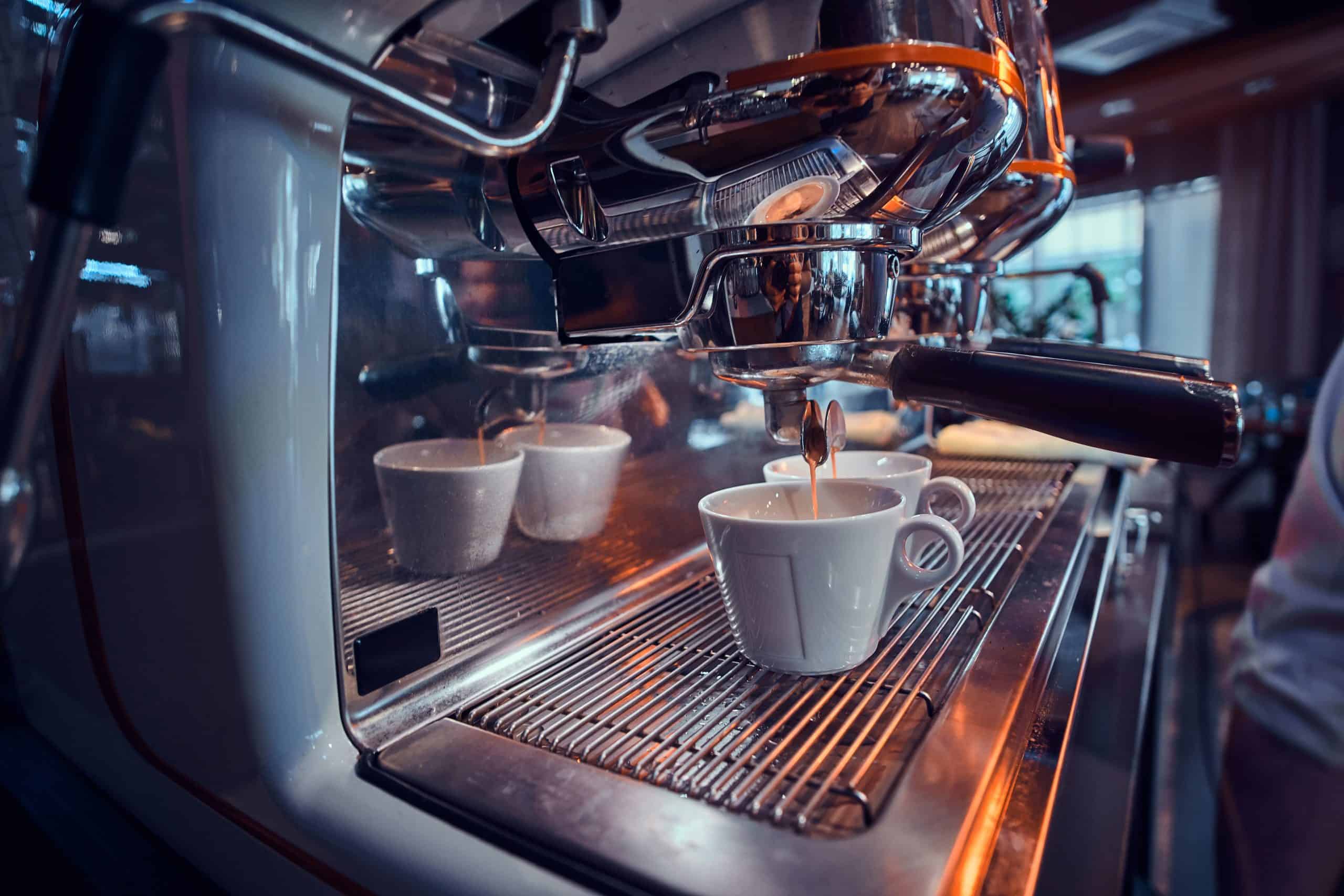
A serious commercial espresso machine — two or three groups, professional steam system, properly engineered boiler — costs between €6,000 and €18,000 outright. Add a quality grinder and you are well into five figures. For most independent cafés, this is one of the three largest investments in the entire build-out, alongside lease deposit and shopfit. Getting the financing model right is not a cosmetic choice. It changes the entire shape of your cashflow for the next five to seven years.
The financial fundamentals
Three financing models dominate the market.
Outright purchase. You pay the full price up front, you own the machine, you handle maintenance through ad-hoc service contracts. Maximum capital lock-up, minimum monthly commitment, full responsibility for upkeep.
Finance lease or hire purchase. A bank or finance company buys the machine and rents it to you over a fixed term (typically 36 to 60 months). At the end of the term you usually own the machine for a nominal payment. Monthly outflow is moderate, you treat it as a capital expense on your books, you handle maintenance separately.
Service-included rental. A specialist provider (often the roaster or a dedicated equipment partner) owns the machine and leases it to you with maintenance, repairs and sometimes consumables included. Monthly outflow is higher than a pure lease, but you have zero ad-hoc bills, and at the end of the term the machine is renewed or replaced rather than depreciating on your balance sheet.
A worked example: 5-year comparison
A specialty café in a major European city, two-group La Marzocco or similar, retail price €10,500. Here is what each model costs over five years, using reasonable assumptions.
Outright purchase: €10,500 up front. Maintenance and service over five years: roughly €450 a year, so €2,250. Total five-year cost: €12,750. Capital tied up: €10,500 from month one.
Finance lease (5 years at 7 per cent): €208 a month for 60 months, plus a small final payment to own. Total payments: roughly €12,500. Maintenance and service: €2,250. Total five-year cost: €14,750. Capital tied up: zero.
Service-included rental: €295 a month all-in for 60 months. Total payments: €17,700. No additional service costs. Machine replaced or refurbished at end of term. Total five-year cost: €17,700. Capital tied up: zero.
On paper, outright purchase looks like the clear winner. It is roughly €5,000 cheaper over five years than the service-included rental, and €2,000 cheaper than the lease. So why do the most successful specialty operators we work with overwhelmingly rent?
Where renting wins
The €5,000 advantage of outright purchase exists only on paper. In practice, several factors quietly shift the comparison.
Capital is not free. The €10,500 you sink into a machine is €10,500 you cannot spend on marketing, on hiring, on a second grinder, on training. If that capital could earn 10 to 15 per cent deployed elsewhere in your business, the implicit cost of locking it up in equipment is significant.
Surprise breakdowns are expensive. A commercial boiler failure outside warranty can cost €1,500 to €3,000 plus three to seven days of lost trading. A service-included contract absorbs this risk; outright purchase does not.
Technology moves. Espresso machines have improved measurably in the last decade: pressure profiling, gravimetric dosing, energy efficiency. A machine bought today will look dated in five years, and the resale value will be 25 to 40 per cent of new. Rental contracts solve this with a refresh cycle built in.
Tax treatment varies. In most European jurisdictions, rental payments are immediately deductible as operating expenses, while purchased equipment must be depreciated over several years. Depending on your tax situation, the cash difference can close the gap further.
Where buying wins
Outright purchase remains the right choice in a few specific scenarios. Operators with excess cash and no high-return alternative for it. Established cafés that have stabilised their volume and are confident in their equipment choice for the long term. Businesses with very low downtime tolerance who have already built strong technical partnerships independent of the machine supplier.
A simple decision framework
Three questions cut through most of the complexity:
1. Can the capital earn more elsewhere in your business? If yes, rent. If no, consider buying.
2. Can you absorb a €3,000 surprise bill comfortably? If yes, renting or buying both work. If no, the predictability of a service-included rental is worth the premium.
3. Are you confident in your equipment choice for five-plus years? If yes, buying is reasonable. If no — and most specialty operators shouldn’t be, because technology moves — rental gives you optionality.
Beyond pure ROI: the hidden factors
The financial models above assume the machine works equally well under each model. In reality, the relationship matters. A service-included rental usually means a deeper relationship with the supplier, faster response times, and proactive maintenance that purchased-machine owners have to chase. The cup that gets pulled when the machine is properly maintained is meaningfully better than the cup pulled when it isn’t.
At Good Cherry, we offer all three models because different operators need different things. The conversation that matters is not which financing structure is cheapest on paper — it is which one fits your business model, your cashflow rhythm, and your appetite for risk.
Want a custom ROI analysis on the equipment you are considering? Talk to the Good Cherry team.